
The internet is a dangerous place for a curious person. How a curious person will survive the internet is not always a straight line, especially when they learn to navigate and make the most out of it.
If you’re a curious person, the internet can feel less like a library and more like a firehose. The trick is not to shut down your curiosity. It’s to give it structure.
Save what matters. Question your sources. Limit the endless scrolling. Turn your curiosity into projects instead of piles of open tabs.
A curious person survives the internet by building a place for curiosity to go.
Understanding How a Curious Person Survives the Internet
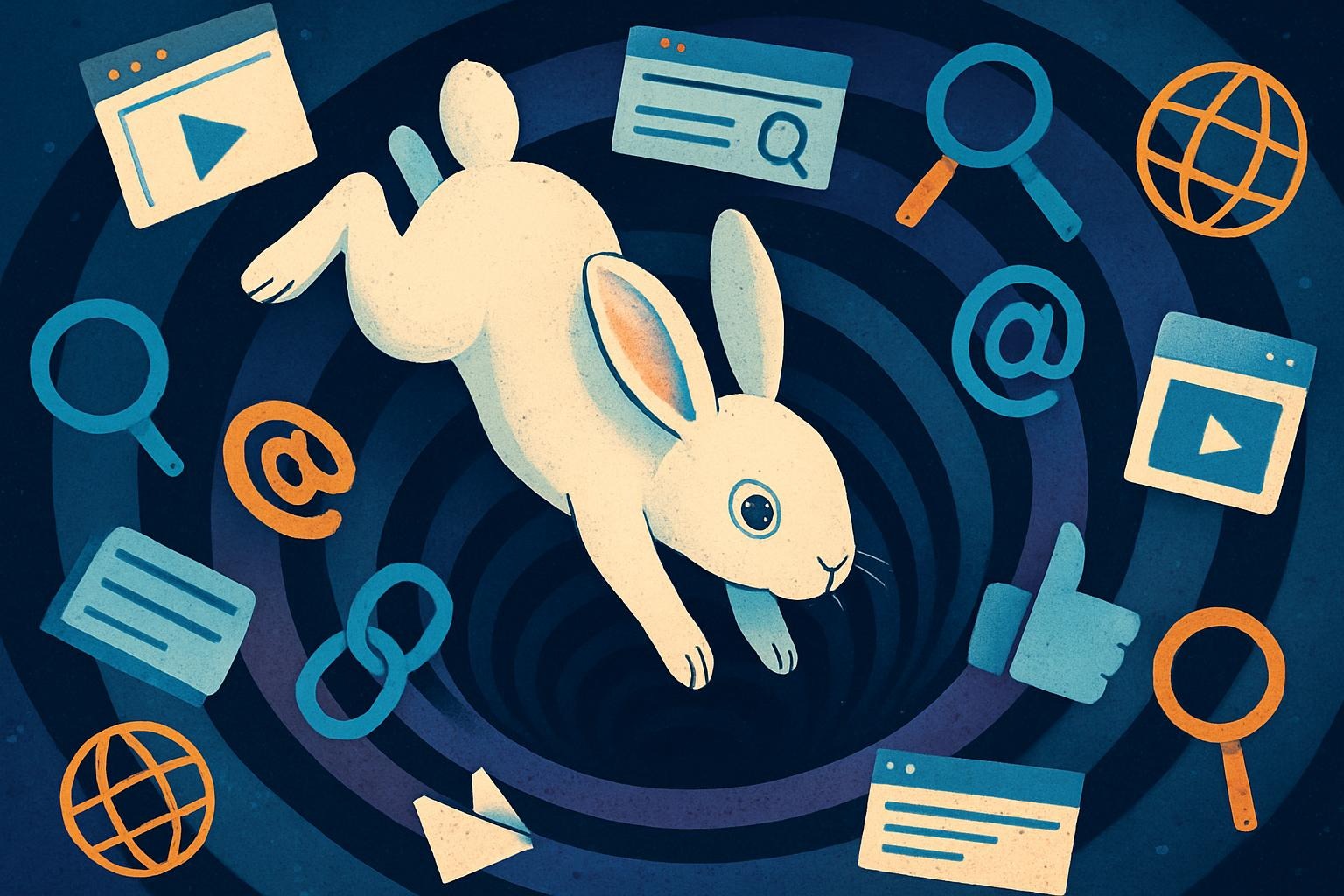
Not dangerous in the “someone hacked my fridge” sense — harmful in the “I was trying to look up a soup recipe and somehow ended up reading about volcanic lightning for two hours” sense. The modern digital world was not designed for people who can become fascinated by anything at any time.
If you’re curious, you already understand the curse:
There’s always one more link, one more article, one more obscure fact you didn’t know you needed until it crossed your screen. To survive this internet landscape, remember it isn’t a library it’s a firehose and curious people keep walking up to it with a teacup. This is the challenge to survive the Internet.
But here’s the interesting part: curiosity isn’t a hobby, it’s a survival instinct.
We collect knowledge the way beavers collect sticks compulsively, instinctively, and often in ways that make other people wonder what exactly we’re building. Some of us see patterns others miss. We make connections mid-sentence, and excited about everything from black holes to banjos. While that curiosity makes life richer, it also makes the internet more complicated.
Because the real problem isn’t that there’s too little information, it’s that there’s too much, and it’s stacked in the wrong places.
People who aren’t curious get overwhelmed.
Curious people get overstimulated trying to survive the internet and they try to absorb everything in their quest to survive the internet’s chaotic nature.
And somewhere in the middle is the rest of the population, living off a steady diet of social media noise, political outrage, recycled misinformation, and whatever headline happens to go viral that week. There is no surprise that people feel lost and conspiracy theories spread like mold in a damp basement. And it’s no wonder so many smart people begin to doubt their own ability to tell what matters.
I was reminded of this watching a recent John Oliver episode about publicly funded local TV stations in the U.S. These stations the kind that produce weather updates, city council meetings, school board coverage were recently defunded by the Trump administration as part of a political pushback. But politics aren’t even the interesting part. The interesting part is the impact.
For many poorer families, those stations were their only stable, boring, trustworthy source of day-to-day information. Take that away, and you don’t magically create a more “balanced” media landscape. You make a vacuum. And curiosity does not disappear just because the ground falls out from under it. It goes somewhere — usually to the loudest, most emotionally charged alternatives available.
Conspiracy theories don’t thrive because people love nonsense,
They thrive because people are trying to understand a world where reliable information is scarce, and their curiosity has been pushed into darker corners.
And this is where life online becomes exhausting for curious people.
Not because we don’t love learning (we do) but because the internet gives us endless noise and very few maps. There’s no organization, no hierarchy of meaning, no quiet librarian telling you, “You know, that source you’re reading is absolute garbage.”
So you either drown or you start building something to hold the pieces-something that makes you feel capable and in control of your curiosity.
So I started building structured digital spaces for my curiosity, creating little boxes that help me slow down and focus on what truly matters.
Underplayed became one of those boxes a place to slow down, breathe, and talk about the music that actually matters. The overlooked. The underrated. The albums that shaped me in ways algorithms never could.
But curiosity isn’t neat. It’s not polite. It doesn’t stay in one lane.
If music scratches one itch, discovery scratches another. And pretty soon, I was filling notebooks and browser tabs with facts so strange and fascinating that I needed a place to put them — somewhere better than shouting “Did you know octopuses have three hearts?” into a void.
It became the home for the weird, the wonderful, the surprising, the things that make the world more interesting and make curiosity feel like a superpower instead of a liability. Instead of drowning in information, I could sort it, shape it, and share it with people who appreciate the joy of learning something new, no matter how small.
And that, I’ve learned, is how a curious person survives the internet:
Not by resisting the pull,
not by pretending we don’t care,
and definitely not by limiting ourselves to “normal” interests.
We survive by giving curiosity a place to go.
A structure.
A home.
A project.
A purpose.
Curiosity doesn’t need to be tamed, cured, or minimized. It just needs to be fed thoughtfully and intentionally, helping you feel confident in your approach to exploration.
It just needs to be fed thoughtfully, deliberately, and with the understanding that some of the best things in life begin with the words:
“I wonder…”